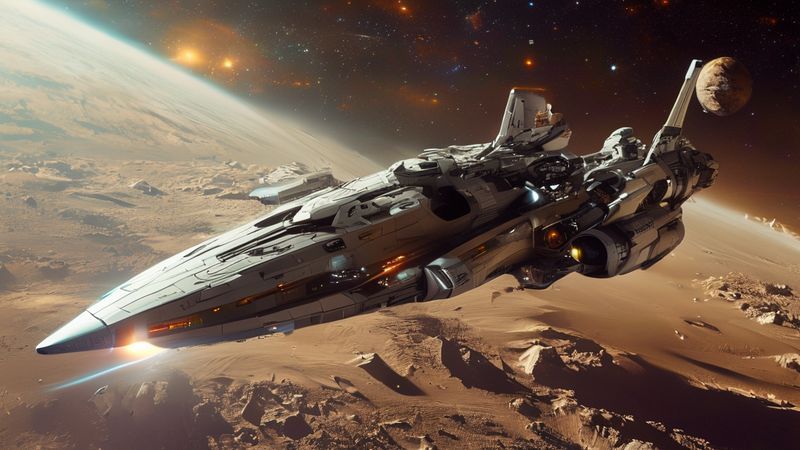
 Elon Musk's ambitious vision to land Starship on Mars by 2026 hinges on a critical planetary alignment, demanding unprecedented rapid development and technological leaps from SpaceX. This post delves into the orbital mechanics dictating this tight launch window and the monumental challenges that must be overcome to meet such a groundbreaking deadline.
For years, the idea of humanity becoming a multi-planetary species has fueled the imagination, a dream often relegated to the realm of science fiction. Today, thanks to the relentless drive of Elon Musk and the engineering prowess of SpaceX, that dream is inching closer to reality, with Mars firmly in their sights. The centerpiece of this audacious plan is Starship, a fully reusable transportation system designed to carry both cargo and humans to the Moon, Mars, and beyond, fundamentally transforming space travel as we know it.
The target for Starship's inaugural journey to the Red Planet is not arbitrary; it's dictated by the unforgiving laws of orbital mechanics. While the idea of reaching Mars feels like a matter of simply pointing and shooting, the reality involves precise timing and complex trajectory planning to minimize fuel consumption and transit time. This is where the concept of a "launch window" becomes paramount, a critical period that opens roughly every two years when Earth and Mars align optimally.

The Orbital Mechanics of Mars Windows
Interplanetary travel isn't like catching a train; it's more akin to hitting a moving target with another moving target while both are orbiting a third, much larger body. Earth and Mars both orbit the Sun, but at different speeds and distances. Earth completes an orbit in roughly 365 days, while Mars takes about 687 Earth days. This difference means that the two planets only come into optimal alignment for a cost-effective journey approximately every 26 months. This period, known as the synodic period, defines the "launch window." Sending a spacecraft outside of this window would require significantly more propellant, making the mission far more expensive and complex, if not impossible with current technology.
During a launch window, the geometry of the solar system allows a spacecraft to be launched from Earth and placed on a trajectory that will intersect with Mars's orbit at the precise moment Mars is at that point. This typically involves a "Hohmann transfer orbit," an elliptical path that uses the least amount of energy to travel between two orbits. Missing this window means waiting another two years for the next opportunity, a delay that can significantly impact long-term colonization goals and the speed of technological progress.
Why 2026 is "The Window" for SpaceX
Given the 26-month cycle, the last major launch window for Mars was in mid-2024. Therefore, the next prime opportunity for a direct, energy-efficient journey to Mars naturally falls in 2026. For Elon Musk, this isn't just a convenient timing; it's a strategic target. SpaceX aims to send an uncrewed Starship to Mars during this window, paving the way for eventual human missions. This 2026 target provides just enough time, in SpaceX's ambitious timeline, to complete the necessary development and testing of Starship.
Critical milestones that must be achieved before a Mars flight include successful orbital test flights of the full Starship-Super Heavy stack, proving its reusability, and perhaps most crucially, demonstrating orbital refueling. A Mars mission requires a fully fueled Starship, which can only be achieved by launching multiple tanker Starships to top off the primary Mars-bound vehicle in Earth orbit. Moreover, successful atmospheric re-entry and precision landing capabilities, both on Earth and eventually on Mars, are non-negotiable. While the 2024 window might have been too soon for all these elements to mature, 2026 represents the next earliest opportunity that aligns with SpaceX's aggressive development pace and long-term objectives for creating a sustainable presence on Mars.
The Unprecedented Challenges and Rewards
While the 2026 launch window offers an optimal timing, the journey to Mars with Starship is riddled with unprecedented technical and logistical challenges. Beyond the orbital mechanics, SpaceX must perfect intricate technologies such as high-volume, automated orbital refueling – a feat never before attempted at this scale. Landing a massive Starship on Mars, navigating its thin atmosphere with precision, and establishing initial infrastructure for power and communications will be monumental. Furthermore, developing robust life support systems, radiation shielding, and in-situ resource utilization (ISRU) capabilities for future human missions are long-term hurdles. Each stage of this endeavor pushes the boundaries of engineering and human ingenuity.
Yet, the rewards of succeeding are immeasurable. Establishing humanity as a multi-planetary species would safeguard our long-term survival, provide an unparalleled scientific laboratory, and inspire generations to come. The technologies developed for Mars missions will have profound spin-off benefits for Earth, from advanced materials to sustainable energy systems. Elon Musk's 2026 Starship to Mars window isn't just a launch date; it's a rallying cry for humanity's next giant leap, a testament to the audacious spirit of exploration that defines our species. The world will be watching as SpaceX races against time and the cosmos to turn this audacious dream into a groundbreaking reality.


